Legacy & history

From glass-forming machines
to critical technologies.

More than a century of engineering, business development and reinvention.

Lynch Glass Machinery · 1917

Engineering ingenuity,
from the beginning.

Our roots reach back to Lynch Glass Machinery Company and the equipment that helped industrialize glass forming. The business was built around an exacting challenge: making complex physical processes work reliably, repeatedly and at scale.

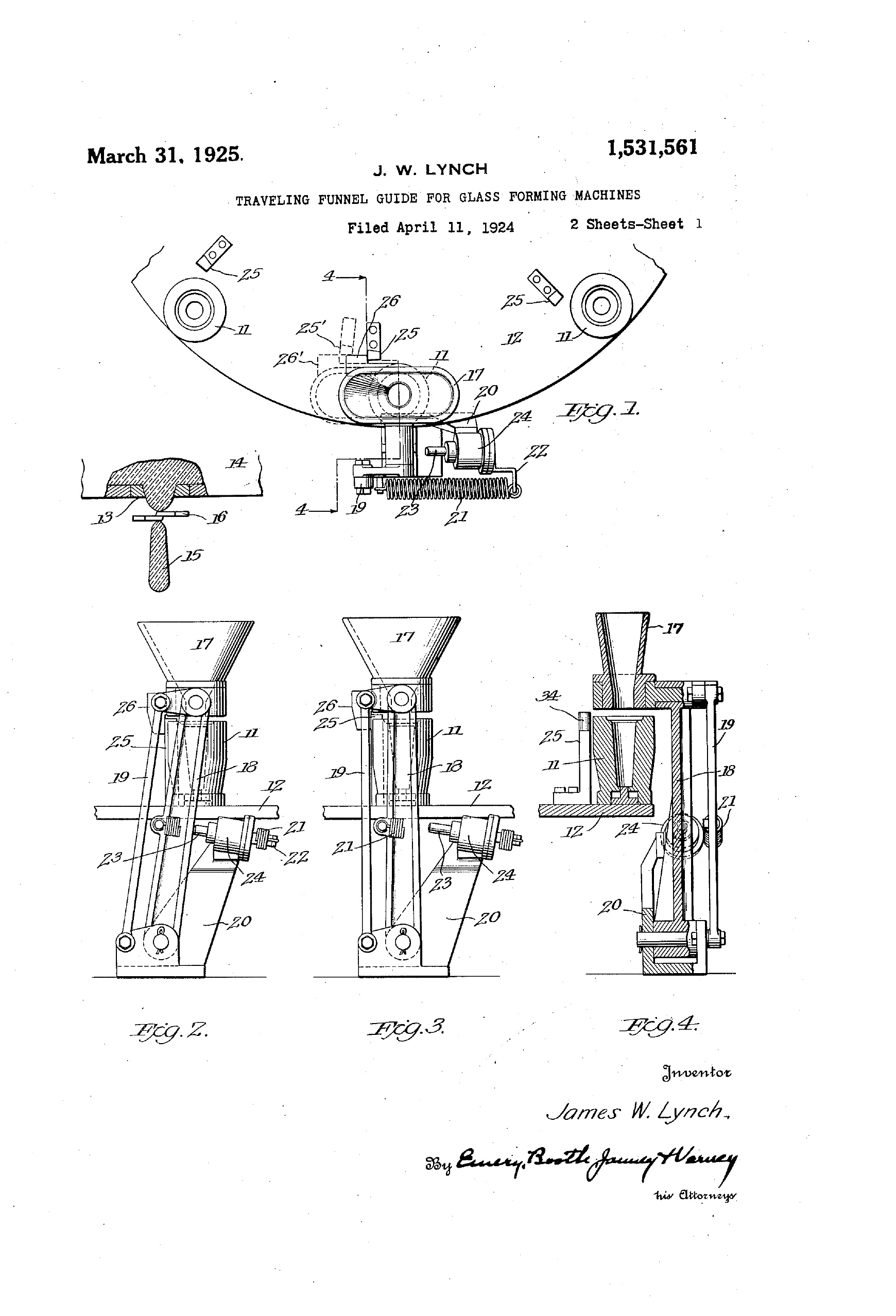
A 1925 patent assigned to Lynch Glass Machinery captures that practical engineering spirit. James W. Lynch designed a traveling funnel that guided molten glass into molds as they moved around a rotating table. By coordinating the funnel with the molds, the invention addressed the repeated stopping and starting of earlier machines.

The drawing is a window into the company’s origins: careful attention to motion, timing and the machinery that makes production possible.

Explore the original patent ↗
James W. Lynch’s original 1925 patent drawing: a traveling funnel guide synchronized with rotating glass-forming molds.
Precision in motion. U.S. Patent 1,531,561, granted March 31, 1925. Original drawing by James W. Lynch, assigned to Lynch Glass Machinery Company, Anderson, Indiana. Select the image to view the full drawing.

Five chapters

An enterprise that keeps evolving.

01

1917–1963 · Glass machinery

Engineering the machinery of industry.

Lynch Glass Machinery began in 1917, during a period when manufacturers were bringing greater speed and consistency to glass production. Its story starts with machines, mechanisms and practical inventions that helped shape an industrial process.

02

1964–1984 · An industrial group

Broadening the operating foundation.

Under Curtiss-Wright control, Lynch expanded its industrial interests. The 1976 acquisition of M-tron Industries, Inc. (“Mtron”) added frequency-control technology, creating a connection to precision electronics that would shape the company for decades.

03

1985–2003 · Ownership and enterprise

A wider field of opportunity.

In 1985, companies affiliated with Gabelli Funds acquired a majority interest in Lynch. Mario Gabelli became Chairman and CEO in 1986. Investments in financial services, transportation and telecommunications broadened the group, while public offerings, sales and spin-offs reshaped its holdings.

04

2004–2022 · Precision electronics

A new identity. An enduring technical focus.

Marc Gabelli was elected Chairman in September 2004. Mtron’s acquisition of Piezo Technology that year deepened the precision-electronics business. The company adopted the name The LGL Group, Inc. in 2006, acquired PTF in 2016 and completed the Mtron spin-off in 2022.

05

2023–today · A holding platform

Building the next chapter.

The launch of Lynch Capital International in 2023 established a vehicle for Merchant Investment. Today, LGL combines that activity with Platform Operations anchored by PTF, continuing to develop businesses and relationships around critical technologies.

Company chronology

Milestones in the LGL story.

A selected chronology of the businesses, leadership transitions and corporate events that shaped the company.

1917

Lynch Glass Machinery begins

The predecessor to LGL is established, developing machinery for the glass-forming industry.

1925

An invention in motion

James W. Lynch’s traveling funnel guide receives U.S. Patent 1,531,561. The design coordinates the delivery of molten glass with moving molds.

1928

Lynch Corporation is incorporated

The company is incorporated in Indiana, establishing the corporate lineage that continues through LGL.

1946

A public-market beginning

Lynch lists on the New York Curb Exchange, a predecessor to today’s NYSE American.

1964–1976

Industrial ownership and electronics

Curtiss-Wright acquires control in 1964. Lynch acquires Mtron in 1976, adding frequency-control components.

1985–1986

Gabelli-affiliated ownership

Companies affiliated with Gabelli Funds acquire a majority stake in 1985, including Curtiss-Wright’s interest. Mario Gabelli becomes Chairman and CEO in 1986.

1986–1989

A diversified group takes shape

Lynch Capital and Lynch Asset Management are formed; investments include Tremont Partners, entertainment and industrial businesses. Morgan Drive Away is acquired in 1988, followed by the creation of Lynch Telephone and the acquisition of Western New Mexico Telephone in 1989.

1991–1997

Building businesses across industries

Lynch expands its telecommunications holdings. Tremont becomes publicly traded through a rights offering to Lynch shareholders in 1992. The Morgan Group becomes public in 1993 and grows its transportation operations. Industrial holdings evolve through Spinnaker Industries.

1999–2002

Portfolio distributions

On September 1, 1999, Lynch Corporation distributes Lynch Interactive Corporation—today LICT—to shareholders. In January 2002, the independent Lynch Interactive distributes Morgan Group Holding Co. to its shareholders.

Read the LICT case study →

2002–2004

A stronger precision-electronics business

Mtron acquires Champion Technologies assets in 2002 and Piezo Technology in 2004. Marc Gabelli is elected Chairman on September 20, 2004, following earlier board service in 2003–2004.

2006–2007

LGL Group identity

Lynch Corporation adopts the name The LGL Group, Inc. in 2006. In 2007, the company reincorporates in Delaware and announces the sale of the legacy Lynch Systems business.

2014–2016

Expanding technical capabilities

Mtron adds Trilithic filter assets in 2014. LGL acquires the assets of Precise Time and Frequency in 2016.

2022

Mtron becomes independent

LGL completes the spin-off of Mtron, which begins trading independently on NYSE American under MPTI.

2023

Lynch Capital International launches

A new subsidiary is established to facilitate LGL’s Merchant Investment activity.

2026

A new chapter from Arlington

Jason D. Lamb becomes CEO. LGL announces its Skyline Instruments investment, completes its subscription rights offering, establishes its Arlington headquarters and redomesticates to Nevada.
A heritage in precision electronics

The wider company chronology includes decades of innovation by Mtron and Piezo Technology: monolithic crystal filters in the 1960s, space applications in the 1970s, oscillator and resonator development in the 1980s, and expanded filter and timing capabilities in the decades that followed. These are milestones of businesses that contributed to LGL’s history; Mtron has operated as an independent public company since 2022.

Historical sources: LGL corporate chronology; 2023 Annual Report; 2005 proxy statement; subsequent company announcements and SEC filings. Patent image: United States Patent Office, U.S. Patent 1,531,561 (1925), digitized patent record.

From our history · Mtron

A business developed.
A new chapter shared.

LGL helped develop Mtron’s precision-electronics capabilities over decades, then distributed the business to shareholders as an independent public company in 2022. Explore the operating story, the one-for-two distribution and Mtron’s subsequent performance.

Mtron has operated independently since October 7, 2022. LGL retained no equity interest after the spin-off.

The next chapter

Rooted in experience.
Focused on what comes next.

Today’s LGL brings operating experience and investment discipline to the development of businesses in critical technologies.